
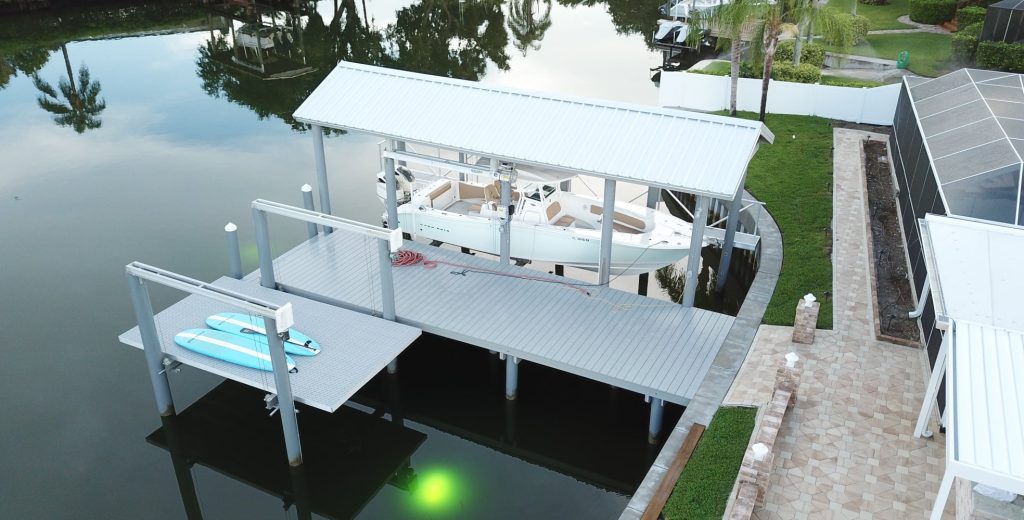
A boat dock is the final touch on a waterfront property. However, it’s also a significant expense, often adding tens of thousands of dollars to the total investment. Is the cost worth it long-term? Which dock construction materials provide the best return on investment (ROI)? Here are some key factors to consider when planning your dock.
For 2026, that question matters even more. Dock construction costs, permitting requirements, storm exposure, and material availability can all affect the real return on a waterfront investment. A dock that looks affordable on the front end may cost more over time if it requires frequent repairs, sealing, board replacement, or storm-related maintenance. That is why ROI should be measured by more than the initial build price.
To better understand what actually affects dock construction ROI, we spoke with Ryan Vess, a partner at Art Marine LLC. Vess works in marine construction and regularly deals with the practical issues that determine whether a dock becomes a long-term asset or an expensive maintenance problem, including permitting, material selection, site conditions, storm exposure, and structural design.
His biggest point is simple: the best dock is not always the cheapest dock. A well-planned project should match the property, the water conditions, the owner’s current needs, and the potential needs of a future buyer.
Key Factors in Dock Construction
A well-built and attractive dock enhances property value, benefiting your family while increasing resale appeal.
In strong waterfront markets, a well-built, permitted dock can materially improve resale appeal, especially when it offers deep-water access, a usable boat lift, good water depth at low tide, and a layout that fits the types of boats buyers in that area actually own. Some real estate professionals estimate that a quality dock can add significant value, but the actual return depends heavily on location, water access, dock condition, permitting status, and buyer demand.
However, not all docks add the same value. Ryan emphasizes that the quality of construction is critical. An aging, unstable structure can deter potential buyers, signaling costly future repairs or replacements. Well-built docks, on the other hand, not only add value but also stand up better to storms and daily wear, reducing maintenance costs over time.
What Buyers Look For In A Waterfront Dock
For resale value, the dock itself is only part of the equation. Buyers want to know whether the dock is safe, permitted, insurable, and usable for the kind of boat they own or plan to buy. A small, aging dock with shallow water access may not add nearly as much value as a well-built dock with the right lift, slip size, and water depth.
Features that can influence dock ROI include water depth at low tide, boat lift capacity, slip size, piling condition, electrical work, covered storage, access to open water, and whether the dock has room for future boat upgrades. These details matter because a dock that fits a buyer’s lifestyle can help sell the whole property, while a dock that needs major work can become a negotiation point.
Planning and Permitting Considerations
Before choosing materials or a design, consider the permitting process. Dock construction is heavily regulated, and requirements can vary by state, county, municipality, waterbody, and environmental conditions.
In Florida, some small private residential docks may qualify for exemption or simplified permitting, but the details depend on factors such as dock size, location, submerged lands, aquatic preserves, seagrass, water depth, riparian lines, and whether the area is classified as Outstanding Florida Waters.
Vess advises homeowners to consult with a marine contractor early in the planning process. A professional can assess riparian lines, setback requirements, environmental concerns, access limitations, and local design expectations before the homeowner spends money on a plan that may not be permittable. In areas with seagrass or other sensitive habitat, the permitting window or allowable design may be more limited.
Homeowners should also remember that local governments, state agencies, and the U.S. Army Corps of Engineers may all have a role depending on the project. A dock that is properly permitted and documented is usually more attractive to a future buyer than one with unclear records or unresolved compliance questions.
Material Choices for Dock Construction
Selecting the right dock construction materials affects initial cost, long-term maintenance, durability, storm performance, and resale appeal. Popular options include wood, composite materials, concrete, aluminum, and PVC.
In coastal areas, storm exposure should also be part of the ROI calculation. A dock that works fine in calm weather may perform very differently when exposed to surge, wind, repeated wave action, floating debris, or heavy boat-lift loads. Pilings, fasteners, decking, roofing, electrical work, and lift components should all be selected for the site, not just the budget.
Wood
Wood remains a popular choice for its affordability and natural aesthetic, especially in freshwater environments. Pressure-treated lumber and cedar are common options. However, wood has significant drawbacks that can reduce long-term ROI.
It is prone to splintering, rot, and marine pests and generally requires considerably more maintenance than plastic-based alternatives. Staining, sealing, repairs, and eventual board replacement all become part of the long-term ownership cost.
Wood can still make sense for some freshwater or lower-budget projects, especially when the owner accepts the maintenance schedule. In saltwater or high-exposure coastal settings, however, the long-term cost of sealing, repairs, splintering, rot, and replacement can reduce its ROI compared with longer-lasting alternatives.
Composite
Composites and plastic-based materials are known for their durability and minimal maintenance. Unlike traditional lumber, they can offer improved resistance to rot, pests, and environmental wear, making them attractive for homeowners looking at the long-term cost of ownership.
Shoreline Plastics, a leading manufacturer of marine construction materials, produces EcoPile, a fiberglass-reinforced composite piling that is resistant to rot and marine boring organisms. EcoPile comes with a 25-year warranty, further reinforcing its long-term ROI despite a higher initial cost than traditional wood pilings.
Vess highlights that composite materials can be particularly beneficial in calm-water areas like bayous, where properly selected products can last for decades with relatively little upkeep.
It is also important, however, to distinguish wood-plastic composite decking from all-PVC decking. Many composite boards contain finely ground wood fiber, often called “wood flour,” mixed into the board. In a typical residential deck, that distinction may receive little attention. On a dock that is constantly exposed to spray, rain, humidity, tidal fluctuations, or even occasional submersion, moisture resistance becomes a much bigger consideration.
Concrete
Concrete docks can offer exceptional longevity with proper maintenance, making them highly durable. However, they also come with drawbacks.
The upfront cost is high, putting concrete beyond what makes sense for many residential projects. Concrete can also develop cracking as conditions shift, and repairs to structural concrete can become expensive.
While concrete is common in industrial or commercial marine construction, it is often difficult to justify strictly on ROI for a typical residential dock. Dock construction and repairs can become particularly expensive when structural problems develop.
Aluminum
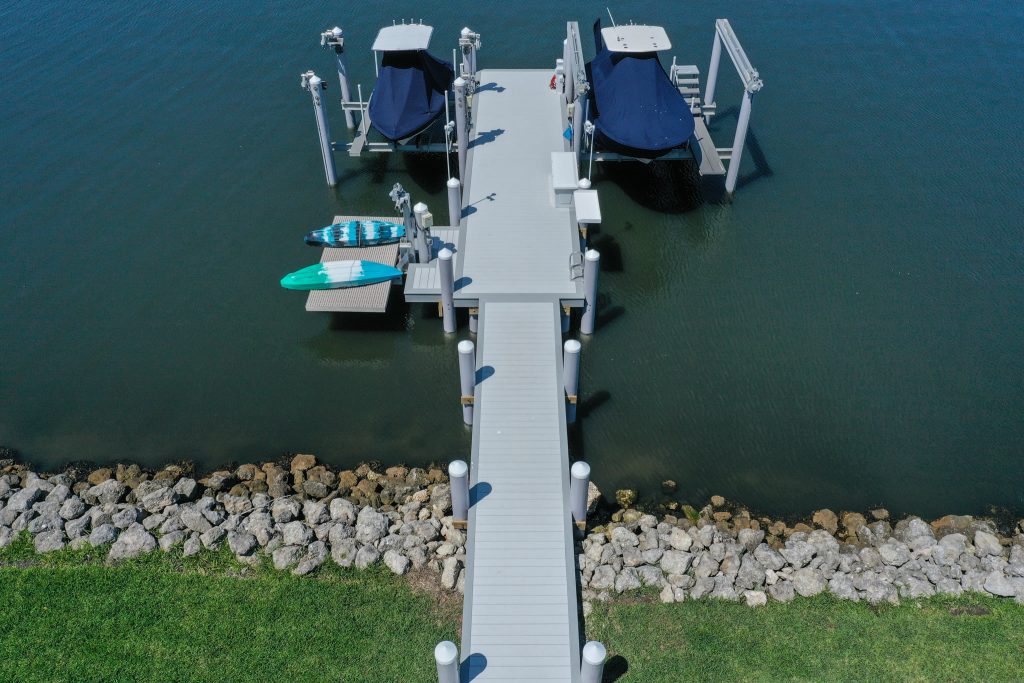
Aluminum is lightweight, corrosion-resistant, and particularly well suited to marine environments. It requires relatively little maintenance and is widely used for dock framing, ramps, gangways, boat lifts, and other marine components.
Eastern Metal Supply, or EMS, is one major supplier of aluminum extrusions and marine-related aluminum products. According to ENDECK Product Manager Charlie Haines, EMS was already supplying aluminum framing and undercarriage materials to dock builders, boat-lift manufacturers, and fabricators when PVC decking became a natural extension of the company’s marine business.
Aluminum generally costs more upfront than conventional lumber, and scratches or cosmetic damage can become visible over time. Premium finishes such as anodizing or powder coating can help improve both appearance and durability.
For coastal dock builders, however, aluminum’s combination of strength, relatively low weight, corrosion resistance, and low maintenance can make the additional upfront expense worthwhile.
PVC
PVC is one of the more interesting materials to consider when evaluating a dock from a long-term ROI standpoint because it addresses many of the problems that make wood expensive to own over time.
One example is ENDECK PVC Decking, an all-PVC decking product produced and distributed by Eastern Metal Supply. Haines said ENDECK’s core is made from pipe-grade PVC rather than a mixture containing wood fiber.
“With ENDECK being an all-PVC, there is no recycled content in it,” Haines said. “It’s a pipe-grade PVC in its core. And then it’s got a capstock layer that’s top of the food chain for weatherability and fade resistance.”
For a dock, the important part of that construction is how the material handles water.
“When you take a product that’s an all-PVC deck board like ENDECK, it absorbs no moisture,” Haines said. “Zero moisture absorption.”
That makes ENDECK particularly interesting for docks where parts of the decking may occasionally — or permanently — wind up underwater.
Haines said ENDECK can be used for applications such as dock stairs that extend directly into the water, including treads that remain completely submerged.
“If you want a set of stairs going down into the water, and you are using ENDECK for the stair treads, and you’ve got the bottom four or five treads going completely into the water, and those things are going to be submerged permanently, it’s just not a problem,” he said.

That distinction matters in coastal areas where storm surge may temporarily submerge decking, as well as on lakes where seasonal water-level changes can leave part of a dock above water during one season and underwater during another.
ENDECK also uses a mineral additive intended to improve stiffness and dimensional stability. Haines said the product can be installed over joists spaced 18 inches on center, while many competing products require 16-inch spacing.
The material’s solid, double-sided profile is another practical feature. Both sides have the same embossed wood-grain finish, which means contractors can use the board in places where the underside remains visible. It also gives a contractor or homeowner another option if the exposed face becomes damaged during installation.
“With ENDECK, you can always take that board up, undo the screws, flip that thing over,” Haines said. “You’ve got a perfectly good usable side on the other side.”
Heat, Traction, and Barefoot Use
Durability is only part of a dock’s value. A dock is also a recreational space, and the walking surface needs to remain usable for people climbing out of the water, carrying fishing gear, checking a boat, or simply sitting outside with their family.
Heat buildup can be particularly important on Gulf Coast docks where decking may sit in direct summer sun for hours.
Haines said PVC naturally dissipates heat and that ENDECK’s lighter colors perform especially well in applications where people expect to walk barefoot. Darker colors still become warmer in direct sun, but color selection gives homeowners some control over surface temperature.
Traction also matters around water.
“It’s got excellent slip resistance whether it’s wet or dry,” Haines said. “It’s really similar. Not a lot of difference between the coefficient of friction wet and coefficient of friction dry.”
That combination of lower heat buildup, a barefoot-friendly embossed surface, and wet-weather traction can make the choice of decking more than an aesthetic decision. If a dock is uncomfortable or difficult to use when it is hot or wet, the homeowner is getting less practical value from the investment.
Maintenance and Long-Term Cost
One of the biggest mistakes homeowners can make when comparing dock materials is looking only at the price of the deck boards.
PVC decking generally costs more upfront than basic pressure-treated lumber. Haines does not dispute that. Instead, he recommends considering how much the decking changes the price of the entire project.
“Don’t look at just board versus board,” Haines said. “Look at the project cost.”
The pilings, structural framing, labor, boat lift, utilities, permitting, and many other costs remain whether the walking surface is pressure-treated lumber or PVC.
Haines gave the example of a dock with approximately $20,000 in material costs using pressure-treated decking. In his example, upgrading the decking to ENDECK might increase the project’s material cost to roughly $22,000. Actual costs will vary considerably from project to project, but the example illustrates an important distinction: a large percentage difference between the price of two individual boards can represent a much smaller percentage difference in the price of the completed dock.
Then there is maintenance.
Pressure-treated decking can require periodic staining and sealing and may eventually splinter, crack, cup, twist, or warp. A homeowner can either pay someone to handle that maintenance or invest his own time doing it.
“If you pay somebody to do it, you’re probably going to make up that difference in five years if not sooner,” Haines said.
ENDECK is low-maintenance rather than maintenance-free. Pollen, dirt, leaves, food, fish residue, and other material can still accumulate on the surface, especially in the South.
Haines recommends treating the decking much like the finish of a vehicle rather than attacking it with aggressive cleaning equipment.
“Keep the pressure washer in the garage,” he said.
Warm, soapy water, a soft nylon brush, and a hose are generally enough for routine cleaning. Haines recommends avoiding harsh solvents and quickly cleaning substances such as insect repellent or sunscreen if they are spilled on polymer decking.
For a homeowner calculating ROI, maintenance has a value even when the homeowner performs the work himself. A Saturday spent staining a dock is still a Saturday that cannot be spent fishing, boating, swimming, or enjoying the property.
As Haines put it, the benefit of a lower-maintenance product is “better quality of life while you have it.”
Choosing the Right Hardware for Your Dock
Selecting appropriate hardware is crucial for the longevity and performance of your dock. A primary consideration is the choice between stainless steel and galvanized steel components.
Stainless Steel Hardware
Stainless steel is an alloy of steel and chromium known for its exceptional strength and resistance to corrosion. This makes it particularly suitable for marine environments, including exposure to saltwater.
Even if scratched, stainless steel maintains strong corrosion resistance, although some cosmetic discoloration can occur depending on the grade and environment. The tradeoff is cost, as stainless hardware can be substantially more expensive than galvanized alternatives.
Galvanized Steel Hardware
Galvanized steel features a protective zinc coating that shields the underlying steel from corrosion. This coating makes galvanized hardware a common and relatively economical option for many construction applications.
Its performance can diminish over time, however, particularly in saltwater environments. If the protective zinc coating is damaged or eventually consumed, the underlying steel can begin to rust.
Making the Right Choice
For docks exposed to saltwater and harsh coastal conditions, stainless steel’s superior corrosion resistance may justify the higher initial investment. In less corrosive environments or projects where budget is the primary concern, galvanized hardware may offer a more economical solution.
Maintenance expectations also matter. Stainless steel generally requires less attention over time, while galvanized components may need periodic inspection and eventual replacement as corrosion progresses.
Companies like Baker Metal Works and Dixie Supply offer a range of metal roofing accessories, including fasteners and closure strips, suitable for various construction needs. While their primary focus is roofing materials, their selection of metal components can be useful for dock and boathouse construction.
Additional Dock Features and Upgrades
A well-designed dock is more than just a place to moor your boat. It can be a functional outdoor space that adds significant value to your property.
Popular additions include boat lifts for easier vessel storage and maintenance, fish-cleaning stations such as KillerDock’s marine-grade aluminum cleaning tables, covered boathouses to protect boats from sun and weather, and extended platforms for fishing, lounging, and entertaining.
Covered Boathouses and Metal Roofing
Adding a covered boathouse can protect a vessel from sun, rain, and daily weather exposure while also improving the overall appearance and usability of the dock. For many waterfront buyers, a covered lift or boathouse is a meaningful upgrade because it makes the property more boat-ready from day one.
When choosing roofing materials for a boathouse, metal roofing is a practical option because it offers durability, weather resistance, and relatively low maintenance. Companies like Dixie Supply and Baker Metal Works offer metal roofing panels, trim, fasteners, and related components that can be used in coastal construction.
Their Tuff-Rib panels are available in a wide range of colors and custom lengths, allowing homeowners and contractors to create a clean, finished look that complements the dock and waterfront property.
In a marine environment, the details matter. Roofing panels, fasteners, closures, and trim should be chosen with corrosion, wind, rain, and long-term exposure in mind.
Fish Cleaning Stations And Aluminum Furniture
KillerDock, a family-owned company based in Theodore, Alabama, produces premium aluminum dockside gear. Its products range from fish-cleaning stations to cabana-style dock furniture and are built from marine-grade aluminum treated with a proprietary anti-corrosion clear coat.
One of the company’s signature designs, the Upscale series fish-cleaning station, features built-in hose hookups in the legs, customizable cutting surfaces, and add-ons such as sinks, drawers, and umbrella holders. For homeowners who want shade while cleaning fish, the Slam series adds a canopy above a fully equipped workstation.
These setups don’t just make a dock more functional. They can add curb appeal for anglers, charter operators, and homeowners who want their waterfront space to look sharp and perform well.

KillerDock has also branched into outdoor furniture designed specifically for marine environments. From aluminum-framed club chairs with removable Sunbrella cushions to cabanas and coffee tables that bolt directly to the dock, the company’s equipment is designed for harsh coastal environments.
Planning for Future Resale Value
Real estate expert Angelo DePaola emphasizes that docks built with future use in mind often provide better long-term value. A homeowner may only need a smaller boat today, but a future buyer may want a larger vessel, a covered lift, deeper water access, or more room for entertaining and fishing.
That does not mean every homeowner should overbuild. It means the design should consider the local market, common boat sizes, water depth, setbacks, lift capacity, and how waterfront buyers are likely to use the property.
The same principle applies to materials.
An inexpensive walking surface that requires substantial maintenance or replacement may make sense when viewed only through the initial construction budget. A more expensive material can make more sense when viewed across the full period of ownership.
That is particularly relevant with products like ENDECK PVC Decking. Its selling proposition is not that PVC is cheaper than pressure-treated lumber on the day it is purchased. It is that an all-PVC surface with zero moisture absorption, submersibility, fade and stain resistance, and relatively simple cleaning can reduce many of the recurring maintenance issues associated with a traditional wood walking surface.

ENDECK also carries a 30-year fade and stain warranty on applicable boards, according to Haines. For homeowners planning to keep a waterfront property for years, warranty coverage and expected maintenance can be just as important to the ROI equation as initial material price.
Is Dock Construction Still A Good Investment In 2026?
For waterfront homeowners, dock construction can still be a strong investment, but only when the project is planned around long-term use instead of short-term savings.
The best ROI usually comes from a dock that is properly permitted, structurally sound, built with materials suited to the environment, and designed for how boaters actually use the property.
In many cases, spending more on better pilings, corrosion-resistant hardware, low-maintenance decking, a properly sized boat lift, or a covered boathouse can reduce future repair costs and improve resale appeal.
That doesn’t necessarily mean choosing the most expensive option in every category. It means evaluating the price difference in the context of the entire project and considering what ownership will cost five, 10, or 20 years later.
The walking surface is a good example. Pressure-treated lumber may remain the right choice for an owner trying to minimize upfront cost. An all-PVC product such as ENDECK may make more sense for someone who places greater value on moisture resistance, submersibility, barefoot comfort, and lower routine maintenance.
The key is to avoid treating the dock as a generic add-on. It should be planned as part of the waterfront property’s total value.
Conclusion
The best dock material depends on your priorities, location, budget, and exposure to the elements.
For affordability and a traditional appearance, wood remains a practical choice, but it comes with greater maintenance requirements. Composite materials provide another durable alternative, while aluminum offers exceptional utility for structural components in marine environments. Concrete provides tremendous durability but is often better suited to commercial or industrial applications than a typical residential dock.
For the walking surface itself, PVC provides another compelling option. Products such as ENDECK demonstrate why the distinction between PVC and wood-containing composite materials matters around water. Its all-PVC construction, zero moisture absorption, ability to tolerate submersion, slip resistance, double-sided profile, and lower-maintenance requirements are all attributes designed around the way docks are actually used.
When planning your dock, don’t overlook the importance of quality components like polymer pilings, corrosion-resistant hardware, durable decking, metal roofing for a boathouse, and well-built cleaning tables, storage, and dock furniture.
The cheapest material on the day of construction isn’t necessarily the least expensive material to own.
For the best return on investment, work with an experienced marine contractor who understands your area’s permitting process, environmental requirements, storm exposure, water conditions, and common buyer expectations. Then evaluate material choices not simply by what they cost today, but by how they’ll affect the dock’s maintenance, usability, durability, and value for years to come.