
The surf can be one of the most interesting places an angler can fish, but surf fly fishing can also be intimidating on a technical level. There is wind, turbulence from waves and current, grass and other obstacles to overcome. There are fish that may be ten feet from dry sand one minute and gone the next. But according to Sam Sumlin, owner of Space Coast Flies and Community Fly Supply in Gulf Shores, Alabama, the whole thing can actually be pretty simple.
Why Surf Fly Fishing Is Simpler Than It Looks
Sam’s approach is not built around carrying the fly fishing version of the kitchen sink. He would rather walk light, cover water, and focus on a handful of proven flies that let him fish quickly and efficiently. That matters because, in the surf, the most important thing is often not having the perfect fly. It is finding the right piece of water.
What You Can Catch in the Gulf Shores Surf Right Now
Lately, around Gulf Shores, that right piece of water has been holding a little bit of everything.
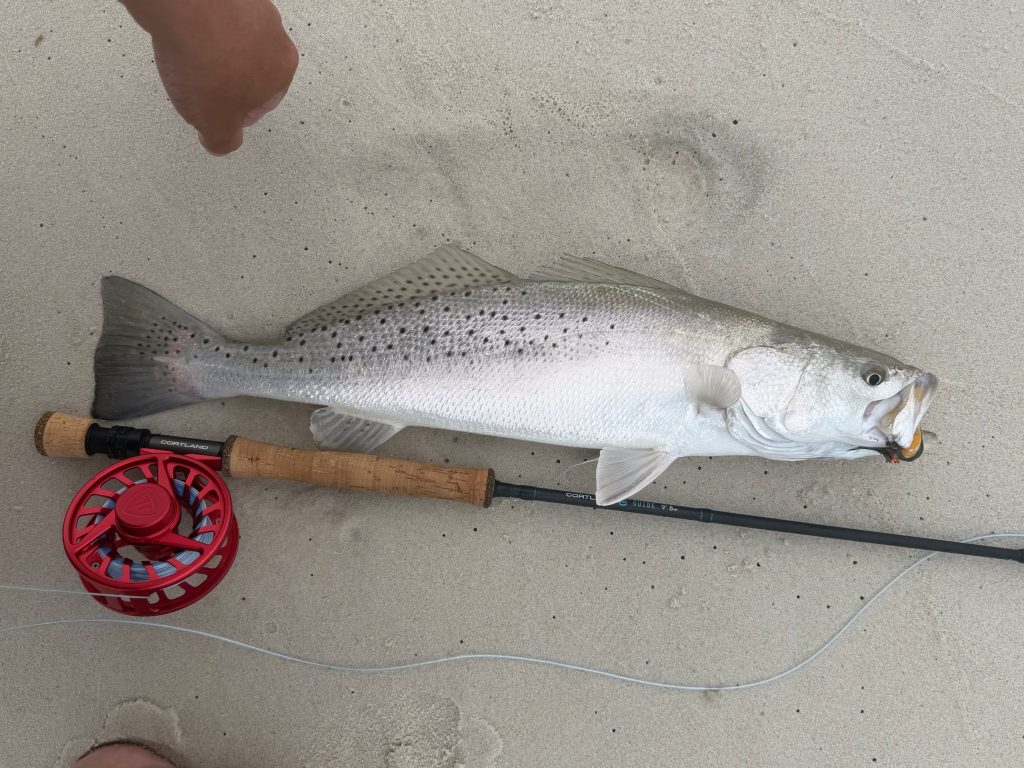
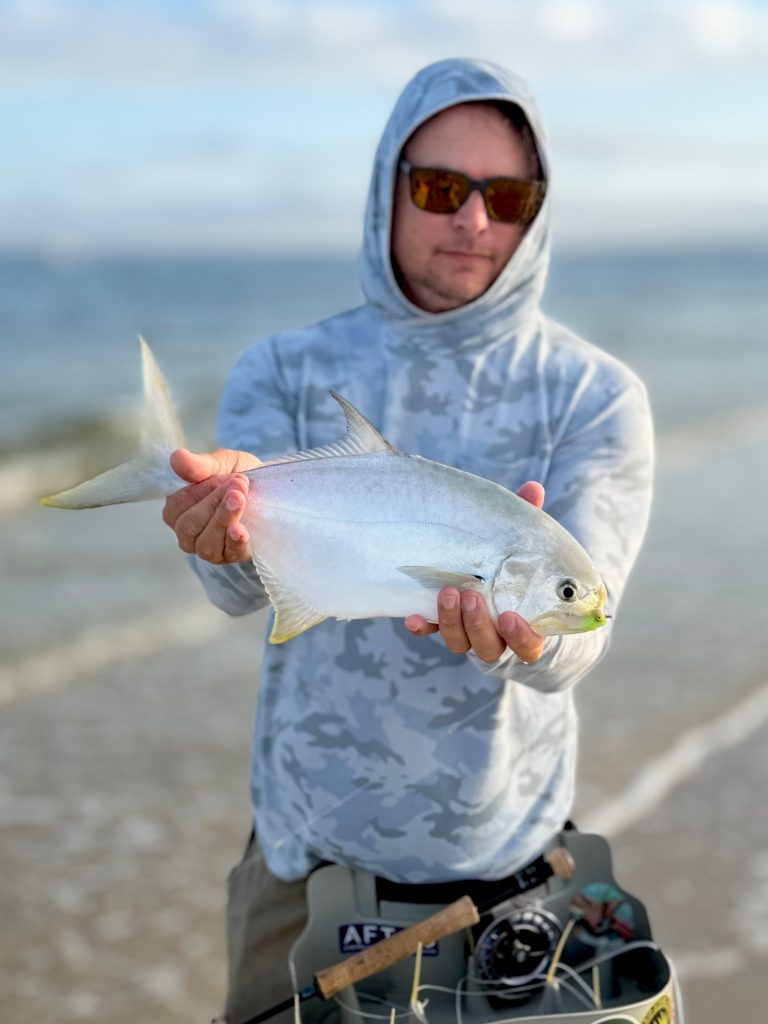
“It’s been a solid mixed bag,” Sam said. “Pompano, redfish, the Speckled trout have really moved on to the beach. That gets real exciting when they get thick in there. Spanish and ladyfish mixed in. Some flounder being caught.”
That kind of variety is part of what makes surf fly fishing so much fun. On the same stretch of beach, and sometimes on the same ledge or in the same hole, an angler can run into pompano, redfish, speckled trout, bluefish, Spanish mackerel, ladyfish, flounder, and more. But it also creates a challenge. You need a setup that can handle several different species without becoming too specialized.
The Ideal Surf Fly Fishing Setup
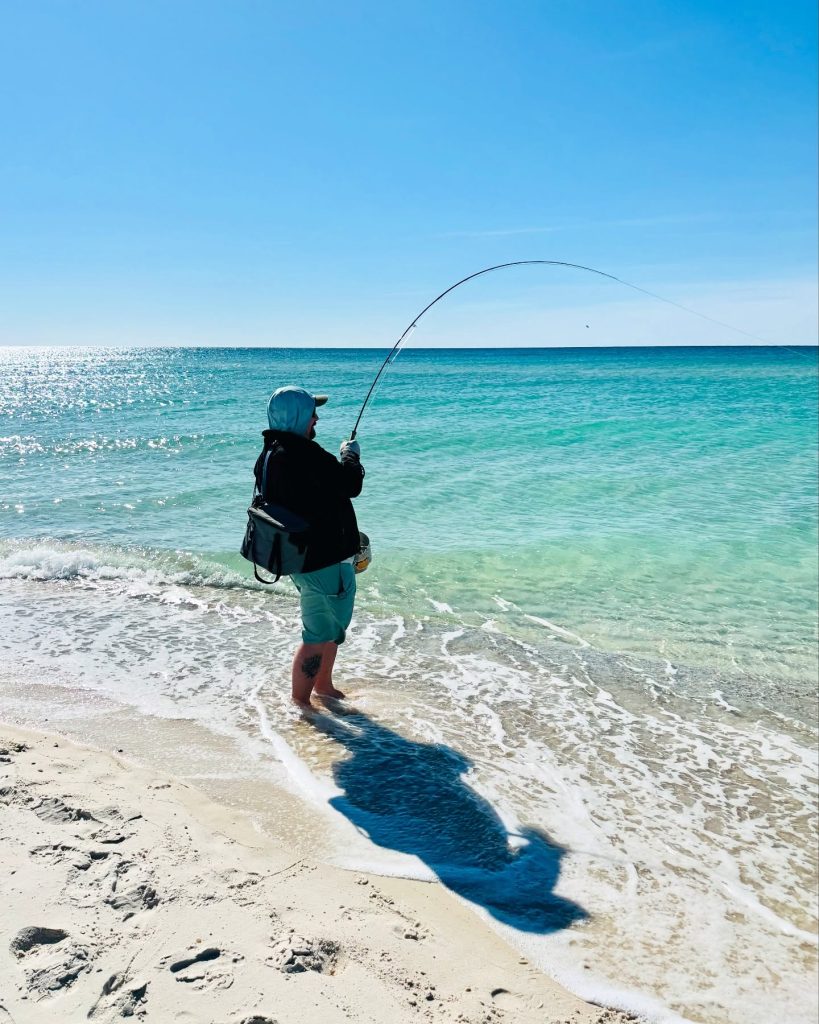
For Sam, that setup starts with a seven-weight fly rod and a full intermediate line.
“Surf fishing, 100% of the time, for myself, I’m fishing a seven-weight rod with the intermediate line,” he said.
An intermediate line is a slow-sinking fly line, and that slow sink is a major advantage in the surf. Floating lines have their place in fly fishing, but they can be difficult when waves, current, and wind are pulling slack around. A full intermediate line helps the fly get below the surface chop and stay in the water column longer. That is especially helpful when fishing troughs, ledges, holes, and other subtle “soft” structures along the beach.
Sam likes that the intermediate line can cover the whole water column. If the fish are holding low, the line helps the fly get down and stay there. If Spanish mackerel, ladyfish, trout, or redfish are feeding higher in the water, the line is not sinking so fast that the fly becomes useless. You can still speed up the retrieve and keep the fly moving in front of aggressive fish.
Gear That Makes Life Easier: Stripping Baskets & Traveling Light
A stripping basket is another key piece of gear. Anyone who has tried to manage loose fly line in the surf knows how fast it can become a mess. Waves grab it. Current drags it. It wraps around your feet. It catches on shells, grass, or anything else around you. A stripping basket, worn around the waist, gives the line somewhere to land between casts and keeps it from becoming a problem at the worst possible time.
After that, Sam keeps the rest of his kit pretty minimal. He is not trying to carry a giant backpack full of flies. He wants a small bag, his phone, and a few patterns that he trusts.
Covering Water: Why Mobility Beats Standing Still
“I like to be light, because I like to put in some miles,” he said. “I cover a lot of ground.”
Surf fish are often grouped around very specific pieces of structure. One stretch of beach may look empty, while another spot fifty yards away may hold nearly every fish in the area. Sam said he recently walked eight miles and caught all his fish within about fifty feet of each other. That is surf fishing in a nutshell. You may do a lot of walking, but when you find the right place, it can turn on fast.
How to Read the Beach: Finding Structure, Bait, and Current
The best places are usually not random. Sam is looking for bait, current, and structure. If he can find two of those three together, he starts to feel like something can happen.
Structure on the beach does not always look dramatic. It may be a hole, a small drop-off, a trough, a point, a color change, or a little ledge where the bottom falls from six inches to two feet. That small change can be enough to hold fish. Flounder especially may use tiny breaks in the bottom as ambush points, but trout, redfish, pompano, and other species will use those same edges when bait and current line up.
Don’t Overlook the Water at Your Feet
“A lot of people think, ‘I’ve got to bomb it out there,’” Sam said. “And that’s just not really the case.”
That may be one of the most important lessons for anglers new to fishing flies in the surf. The fish are not always on the far bar. They are not always past the breakers. They may be right in the first trough, close enough that an angler standing on dry sand can reach them easily. Sam said some of his recent fish were caught with his toes still in the sand.
That close water gets overlooked. Many anglers walk straight past it or wade through it to reach deeper water. But in the right conditions, the first trough can be one of the most productive places on the whole beach. If deeper water swings in close to shore, or if a small hole forms within casting range, it is worth slowing down and picking apart.

Sam also watches for bait. Sometimes a good-looking spot may seem empty until the tide changes, the current starts moving, or bait pushes into the area. When that happens, fish may show up almost instantly. Birds can also give fish away, especially when Spanish mackerel, ladyfish, or other fast-moving fish are pushing bait near the surface. But a lack of birds does not mean a lack of fish. Much of Sam’s recent success has come from blind casting into likely water rather than casting only at visible fish.
Blind Casting vs Sight Fishing in the Surf
“I would say like 80% has been blind casting, or more,” he said.
That may surprise people who think of fly fishing as mostly sight fishing. There are sight fishing opportunities in the surf, especially when the water is clear and redfish or trout are cruising. Sam is always looking. He watches for fish, bait flashes, color changes, movement, and any clue that tells him where to cast. But in day-to-day surf fishing, blind casting is often the main game.
That is where having a repeatable presentation matters. Sam does not just cast randomly and hope. He starts deep, especially when fishing a ledge or hole. Because flies are much lighter than most conventional lures, they do not sink as quickly. That makes the fly line and the countdown method important.
Dialing in Your Presentation: Countdown and Retrieve
“I usually do a countdown method,” Sam said. “I’ll cast and I’ll count to 10. I’ll start with a 10 or 15 count. Work that through the column.”
Once the fly reaches the depth he wants, Sam often fishes it with two hard strips and a pause. That pause is important, especially for speckled trout. Weighted baitfish flies and shrimp-style patterns can jig and fall in a way that triggers strikes. Trout in particular often eat on the fall, so a strip-strip-pause retrieve can be very effective when they are holding on the beach.
If he does not get bit deep, Sam adjusts. He may count down to five instead of ten or fifteen. He may change the speed of the retrieve. The point is to keep track of what he is doing so he can repeat what works. Counting the fly down gives him a better idea of where it is in the water. Without that, it is easy to fish too high, too low, or too randomly.
Fly Selection: Keep It Simple and Effective
Fly choice can stay fairly simple. Sam likes a small group of proven patterns rather than a giant box full of options. One of his go-to flies is a Gravity Minnow, which gives him a mullet-style profile with a slightly broader head and enough weight to get down. He also likes his Neon Icon, a bright shrimp and baitfish hybrid that has been especially productive in the surf. Chartreuse and pink have both been strong colors for him.

For general fishing, a two- to three-inch weighted baitfish pattern covers a lot of ground. White, white and chartreuse, and a few natural colors are good starting points. The fly needs to be heavy enough to fish properly in the surf, but not so heavy that it becomes miserable to cast all day.
When to Downsize Your Flies
Downsizing is another important move. When fish get picky, especially redfish in clear water, Sam will go small. Sometimes that means a tiny size 6 bonefish-style fly, only half an inch to an inch long. That may seem too small for a redfish, but Sam said big reds will still eat them. Those same small flies can also be useful for whiting and pompano, especially when they are circling in troughs and feeding low.
Dealing with Toothy Fish Like Spanish and Bluefish
There is one reason to carry multiples, though. Spanish mackerel and bluefish can make quick work of a fly box. Sam said he recently lost three flies in three casts. When those toothy fish are around, it is not enough to have one favorite pattern. You may want several copies of the same fly because the action can get expensive fast.
Surf fly fishing also has room for wild cards. A popper can be worth carrying. A few different colors or profiles may help when conditions change. But Sam’s larger point is that an angler does not need a hundred different flies to be effective. A few baitfish patterns, a shrimp or hybrid pattern, something small for picky fish, and maybe a topwater option can handle most situations.
Reading Changing Conditions and Beach Structure
The same practical thinking applies to where to fish. Satellite imagery can sometimes help locate troughs, bars, and points, but beach structure changes constantly. A little swell or wind can fill in a trough or shift a hole down the beach. Sam has seen good spots disappear or move after just a couple of days. That means there is no substitute for walking, looking, and learning what productive water looks like in person.
Fishing Jetties and Structure: Risk vs Reward
Jetties and rocks can also produce, though they bring their own challenges. Sam mentioned anglers catching nice redfish and pompano from the jetties during the Gulf Coast Classic, along with reports of good trout around the pass. Fishing from the rocks with a fly rod can be tricky and even dangerous. Line management is harder, footing matters, and casting space may be limited. But if an angler can safely get a fly into the right zone with a sinking line and a baitfish pattern, those fish are there.
The Simple Approach to Getting Started
Still, for many anglers, the cleanest entry point is the open beach. Take a seven-weight, an intermediate line, a stripping basket, and a small box of flies. Look for color changes, troughs, holes, current, birds, and bait. Do not ignore the water at your feet. Cast to the close ledges before wading through them. Start deep, count the fly down, and work the retrieve with intention.
Why Surf Fly Fishing Keeps You Coming Back
It is not always easy. Some days the fish are scattered. Some days the wind makes casting ugly. Some days you may walk a long way before anything happens. But that is part of the appeal. Surf fly fishing rewards motion, attention, and a willingness to keep looking.
When it comes together, it can feel almost ridiculous. One small hole or ledge may hold pompano, redfish, trout, Spanish mackerel, ladyfish, and flounder all at once. You may spend hours searching, then suddenly find fish stacked in one narrow stretch of beach.
The beach is always changing. The bars shift, the troughs fill, the bait moves, and the fish move with it. Fly fishing from the surf is less about solving it once and more about learning how to read it every time you step onto the sand. With the right line, a few dependable flies, and enough willingness to cover ground, the surf becomes a lot less intimidating and a lot more interesting.