

The more you study the habits of deer – learning their haunts and understanding their movements – the better deer hunter you’ll be. When I first met avid bowhunter Dr. Bob Sheppard of Tuscaloosa, Alabama, he’d spend all day in his tree stand to attempt to take a buck deer. However, after years of studying and keeping records on when deer move, Sheppard points out that he hunts less and takes more nice bucks since he’s learned more about deer movement.
Learning Deer Movement Patterns Before The Season Starts
The buck’s movement patterns before the season starts are the patterns he’ll follow naturally and normally when he’s not spooked and doesn’t have hunting pressure exerted on him. Learning these patterns is primarily for the bowhunter and the blackpowder shooter and may hold true for the first of gun season. But when the woods are full of hunters, and deer are moving more from fright than for any other reason, these patterns often don’t work.
“I begin to scout 4-6 weeks before deer season begins,” Sheppard reported, “If you start any sooner, the deer’s feeding patterns may change, and the foods they have depended on before may not be the same they rely on during the season.”

Early-season scouting is primarily for deer moving to or away from their feeding areas which are often agricultural crops.
“To increase your chances of taking a buck, you need to pinpoint where tracks go into and come out of the field at the same point, which is where the likelihood of catching a deer entering or leaving a field is the greatest,” Sheppard explained. “Although deer generally will come through the same region day in and day out, they’ll also meander through an area. If they start from a point to move into a field on a particular day, they may use the same point to go out from the field. Or, if they come into the field from the place you’ve predetermined, then they may meander out in another direction. But usually, deer will prefer to use one or two places along the edge of a field to enter – primarily corners of the field that back into the woods or where the land funnels back into the woods.”
Many hunters have learned that the best way to scout a field to learn deer movement is immediately after a rain. The tracks will be fresh and you can pinpoint the places with the most deer movement that reveal tracks moving in both directions.
Understanding Deer Movement During Deer Season
After deer have felt hunting pressure, their movement patterns change, which often will occur after the second week of bow season, if considerable pressure has been put on the animals from other hunters. Because the deer realize they’re having hunter encounters during daylight hours, they’ll feed after dark and stay away from their food sources until nighttime. Therefore tree stands and ground blinds will have to be moved from the food source to another place, if you want to consistently bag deer. In order to know where to move your tree stand to, additional scouting is required.
One of the signs that indicates a hunter should begin to scout for a new place to put his tree stand is when he sees deer entering the field from several different directions. He may learn that when he moves his stand to set up an ambush, the deer may not come out consistently in the same place every day. He also may notice that he doesn’t see as many deer move into the field during daylight hours. But after a rain, he observes just as many tracks in the field as he has at the first of the season.

To put your stand in a more-productive area, the most-effective technique is to back that stand up to a point in the woods the deer are coming into prior to entering the field after dark.
“To locate this region, I’ll scout on the days when the weather or wind conditions aren’t right for hunting,” Sheppard said. “Common sense is your best tool to find that staging area after the deer have quit showing-up in the field. The most-reliable signs for locating deer are identifying places in the woods where the deer’s feet hit the ground regularly.”
“Go to the trail where you’ve hunted effectively during the early season, and follow the trail away from the food source into the woods. I’ve gotten down on my hands and knees before to track deer further back into the woods away from a primary food source two to three weeks after the season begins. Using this tracking method may not help you understand the total deer-movement pattern. However, you’ll have a better picture of what the deer are doing and will know where you should place your tree stand than you’ll have had by sitting on the edge of the field, waiting for the deer to show-up,” Sheppard advised.
You may backtrack one deer 100 yards and find a place where two or three trails cross. Or, you may continue to follow a trail and locate the edge of a slough where 40 deer walk down that slough’s edge regularly. By following one deer trail away from the food source, more than likely you’ll discover an area where many of the deer using that field as a food source will concentrate prior to entering their feeding ground. Once you discover a region like this, you’ll see many tracks going in both directions. That’s where you want to set-up your stand for the first part of gun season.
However, instead of relying totally on one of these staging regions away from the field, the consistent hunter will follow four or five trails out of the field going in different directions to several staging areas. In each of these staging areas, he’ll locate a tree for his tree stand. If he’s a bowhunter, he’ll cut shooting lanes in four directions from the tree where he plans to place his stand. Also with his compass, he’ll know which way the wind must be blowing from for him to hunt a stand. If his tree stand faces north, then the best time for him to hunt out of that stand to keep his scent from being carried into his hunting area will be with a prevailing north, a northwest or a northeast wind. Using this system of patterning deer, the hunter will have at least one tree stand he can hunt from in the staging area – no matter what the wind condition is.
“Remember that after the hunter has taken a deer or has shot at and missed a deer in these staging areas, the deer begin to learn they’re in danger when they enter these staging zones,” Sheppard emphasized. “They’ll show up in lesser numbers and finally, not at all during the daylight hours. Then the deer will wait until later in the evening to enter the field or come out earlier in the morning, which makes successful deer hunting harder. When you begin to backtrack the deer even further from the staging area, the trailing becomes more difficult, because more leaves are on the ground and following the deer trails becomes more difficult.”
Scouting For Deer Movement Later In The Season
The more you look at deer tracks, and the harder you search for tracks, the better you should be able to interpret what the deer are doing when they’ve made the tracks. So far, we’ve found the buck at his primary food source, which we’ve designated as a field. We’ve backtracked him through what we’ve called a staging area where several deer crossings meet, and where he seems to wait for the cover of darkness to enter the field.
Now we have to go even further into the woods to discover the holding region where the deer stay during daylight hours when hunting pressure is intense, which is the most-difficult pattern to try and interpret. If you can follow a deer track and find some type of thick cover – a briar thicket, a pine thicket, a cut-over field or some kind of heavy foliage where the deer can hide in during daylight hours – then you’ve located a region to scout for your end-of-the-season hunting.
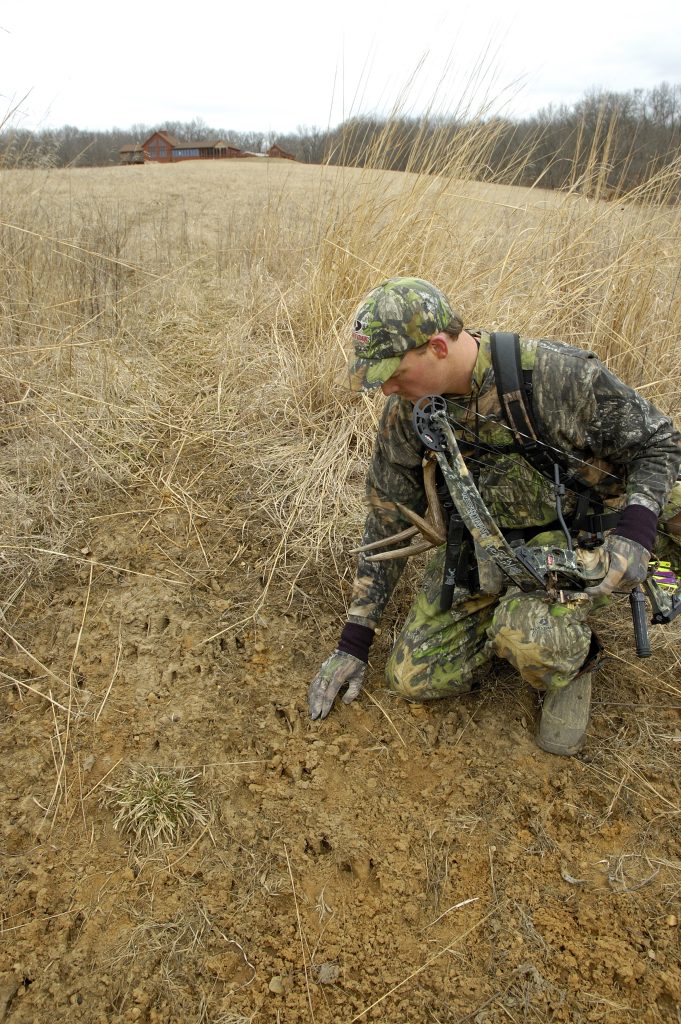
“Scouting thickets is much like the scouting you’ve done in the beginning of the season when you’ve scouted the fields,” Sheppard explained. “Walk all the way around the thicket. Find tracks going both into and out of the thicket at the same place. If the thicket is large enough, and more than one deer is utilizing this cover during daylight hours, you may be able to pinpoint several places on the edge of the thicket where the tracks go both into and out of the thicket. Place a tree stand there, or designate a tree or a ground blind site for a stand. Take your compass out, and determine which way your stand must be facing, and which way you’ll have to approach that stand with a favorable wind. Then you can plan your hunt and decide which stand you’ll hunt out of according to wind direction on the morning of your hunt.”
Sheppard has learned that the advantage to using these stands is you can catch your deer in the mornings coming from the food source and going into the thicket or in the middle of the day – if they’ve been spooked by another hunter coming into the thicket. These late-season thicket patterns may be your best, all-day hunting. All these patterns work well during gun season in areas with little or no hunter pressure.
End Of The Season Attention To Detail
At the end of the season, strict attention must be paid to every detail. The deer are alerted and looking for danger. Although the wind is a key factor for keeping the hunter’s scent out of his hunting spot. An ozone generator can help with this but equally as important is the hunter’s approach to the stand.
“When gun season is on, I rake a path from my tree stand back 150 yards toward where I enter the woods,” Sheppard reported. “Then on the day I hunt, I can walk to my stand without making any noise. I normally take 15 minutes to get to my stand during the first part of the season, but I may spend an hour covering the same distance in the later part of the season to keep from spooking the deer.”
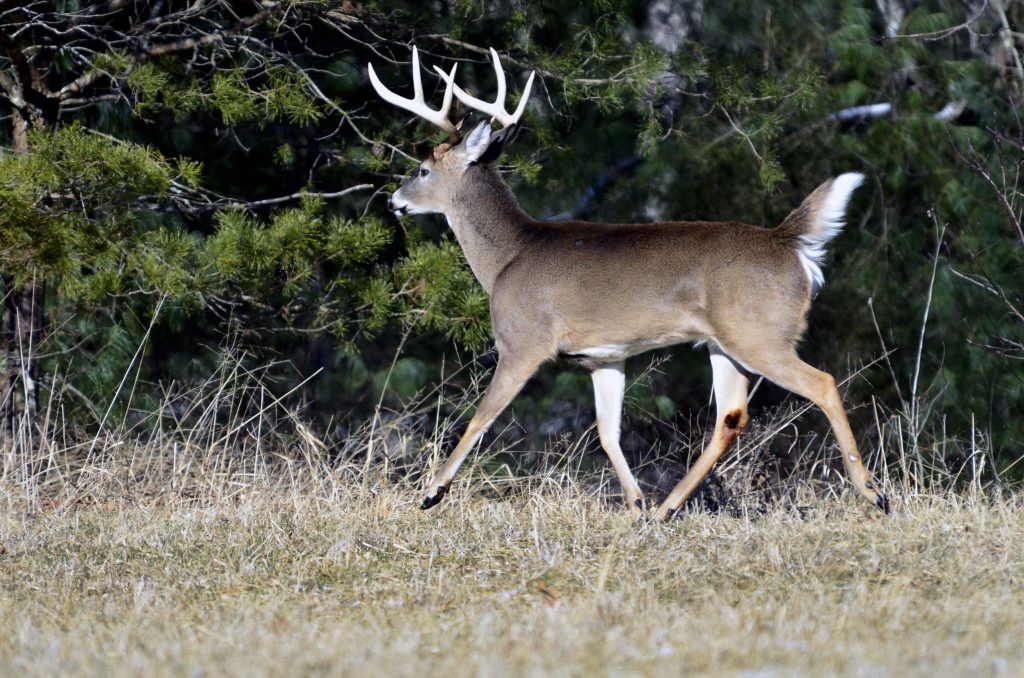
Many hunters prefer using permanent stands or ladder stands in the late season to make little or no noise. The most-difficult bucks to pattern and hunt are those that have spent all season long learning what hunters do, and when they do it.
Moon Phases And Deer Movement
Although no absolutes exist about when deer move, many hunters have reported they believe that moon phase impacts deer movement. However, no one element absolutely affects deer movement. The hunter also must factor in wind, weather, the time of the rut and the amount of hunting pressure deer have had on the property he’s hunting.
Here’s what scientists have learned about the moon phases that some successful hunters factor in to predict when deer move. The scientists have found the moon phase is a marker, but not the actual cause and effect that makes deer move. The actual cause for deer to move is the temperature and not the moon phase. Temperature has a greater bearing on deer sightings than moon phase. In other words, if a cold front hits during a bright moon, then the deer will move. But a bright moon phase and warm weather means hunters won’t see many deer. Scientists have learned many factors causing deer to move, but temperature is the overriding factor.
By investing more time scouting and studying deer and their movement patterns and learning where they feed, where they wait to feed, and where they hold when hunting pressure is on, you’ll be better able to predict at what point in the woods to place your tree stands or ground blinds for an effective hunt.
Full Disclosure: This post may include affiliate links. There’s no extra charge to our readers for using these.