

Golden Shiners can be found throughout North America. They belong to the family Cyprinidae, which is the largest family of fish in the world and includes other members like carp and minnows. They are easily recognizable by their shiny, golden or silvery bodies. Breeding males exhibit orange-hued fins, and wild individuals are quite beautiful in an understated way. They grow to about 3 to 7 inches in length, but they can reach sizes up to 12 inches in optimal conditions.
Since they are not particularly strong swimmers, Golden Shiners prefer calm, vegetated waters and are commonly found in ponds, lakes, backwaters, and marshes. They thrive in a variety of environmental conditions but favor areas with abundant aquatic plants, which provide cover from predators and serve as spawning grounds.
Heavy vegetation also provides ample food. Golden Shiners are omnivorous, feeding on a wide range of food sources including algae, small invertebrates, zooplankton, and detritus. They are schooling fish, often seen in large groups, which also helps protect them from predators.
Shiners As Bait Fish
Golden Shiners are one of, if not the, most popular species for freshwater bait fishing in North America. Shiners lack protective spines on their dorsal and anal fins, and are easily eaten by piscivorous species. Bass, crappie, and catfish will all readily eat Golden Shiners, as will rough fish species such as bowfin and pickerel.
Shiners are easy to cultivate in farm ponds, which means they are economical to produce. Anglers looking for live bait can buy shiners from local bait shops easily; whether they’re looking for 2-3” long “crappie minnows” or 6-12” long behemoths for bass and catfish.
Shiner Fishing For Big Bass
A mature shiner is a meaty but easy-to-swallow meal for a hungry, trophy-sized bass. Especially during the winter, there are few better ways to catch a really big bass than to free line a big shiner into deep water. Shiners can also be fished under a “bobber” made by blowing a small breath of air into a regular old party balloon. This jumbo-sized float will provide good resistance to a large shiner, preventing him from pulling it down into weeds and getting tangled or tiring himself out.
When fishing with shiners, one of the biggest challenges anglers face is keeping bait frisky. Dead and dying shiners won’t catch bass nearly as well as active fish that are swimming around “searching” for bass and triggering strikes by darting away from nearby bass.

It’s important to keep shiners cool and well-aerated, and to handle them as little as possible. This will ensure that they stay lively. Since big shiners aren’t cheap, taking good care of them is worth a little extra time and effort.
How To Hook Bass Shiners
How you hook a shiner also plays a big part in how well it catches bass. While you’ll hear different things from different people, I personally prefer to hook shiners through a nostril, running the hook from the inside roof of the mouth and out the nostril. This method causes the least amount of damage to the fish, letting it stay more active for a longer period of time. It also keeps the hook point facing up and generally out of trouble from snags and weeds. While the fish may appear to be barely hooked, it’s fairly hard to fling the bait off the hook this way. Finally, while you can hook a shiner in the tail or through the back, a bass will always eat a bait-fish head first. By hooking through the nostril, you give yourself a better chance of a good hookset when the bass takes the bait.
How To Catch Shiners
While you can buy shiners from almost any good bait shop, catching your own can be worthwhile. Big shiners are expensive, and may cost several dollars per individual fish. Shiners purchased at bait stores can also be in rough condition by the time you get them. They’re generally transported long distances in tanks on the backs of trucks, which is especially rough on the fish in hot conditions. If your bait shop isn’t selling lots of bait, they may also sit in an over-crowded bait tank for a long time. Diligent bait shop owners regularly remove dead and dying fish to keep from poisoning the live ones, but best practices may not always be followed.
If you’re looking to improve the quality of your live bait by catching your own, there are two main ways to go about it. First, shiners can be caught in small cast nets or seines where legal. But in the weedy areas where Golden Shiners are most likely to be found, catching them with a hook and line is both fun and practical.
An ultralight spinning rod with 2-4lb test is plenty of rod for even large shiners. For bait, segments of red wiggler worms are cheap and easy. Go small with your hook. Size 8 aberdeens will work, but to really improve hookup rates a size 12-14 3x fly fishing hook works great. Bait can be freelined or suspended under super-sensitive quill floats that will indicate the often light takes.
For added enjoyment, consider a 3wt or smaller fly rod. Large shiners will readily take traditional trout flies, and since they are a schooling species the action can be really hot when you locate them. With a lightweight rod, it may surprise you how much fun catching your own bait can be.
Stocking Golden Shiners In Your Pond
For managers of private ponds, Golden Shiners provide excellent forage for bass. Norm Latona at Southeastern Pond Management has been helping landowners manage their bass ponds for a long time, and knows that big bass have big appetites that are hard to sustain without a little help.
“Largemouth bass like to eat, eat and eat,” Norm says, “and they can eat themselves out of house and home, especially if pond owners don’t make sure that there is a good balance between the predator bass population and the forage fish population. With largemouth bass, it is hard to keep groceries around!”
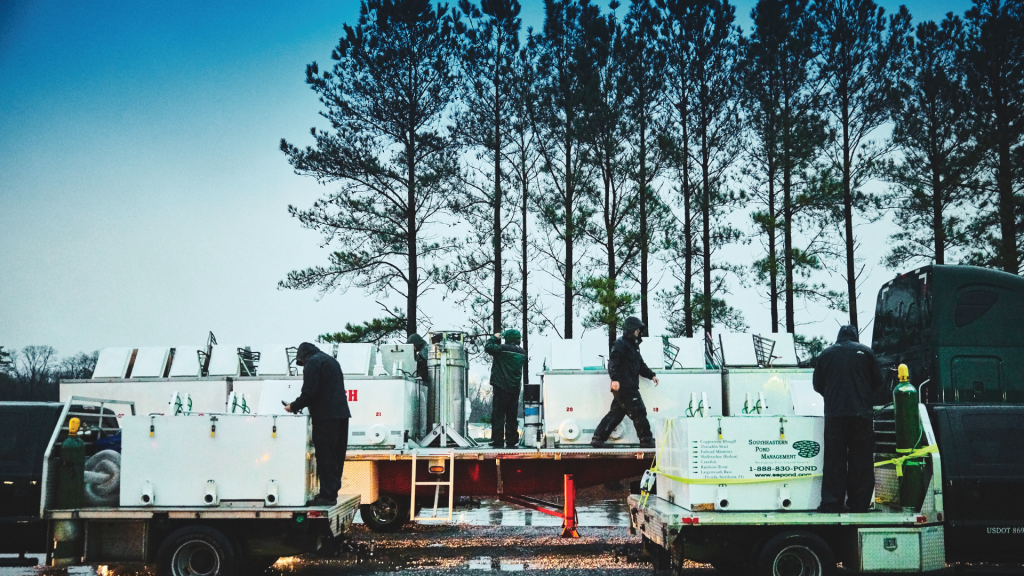
If you’re looking to help out with bass groceries, stocking Golden Shiners in your pond may be a good move. As a native species, shiners are resilient to hot summers and cold winters. They are also prolific breeders, meaning that once established in numbers sufficient to resist predation, they’ll keep producing a steady supply of bass food.
Shiners are also good bass food throughout their life cycle, unlike bluegill, which can quickly grow to a size where they’re competing with bass for nutrients instead of feeding them.
“Bluegill are ideal forage for bass when they’re at what we call intermediate size,” Norm explains. And we define that as about three to five inches. And what can happen if you’re not careful, is you’ll have a pond that has big bluegill and skinny bass. Once a bluegill gets to be about the size of your hand, there’s just no way those bass can eat them. As soon as those bluegill reproduce, they spit out lots of tiny fry that will quickly grow up to an inch or two long. At this point, bass will start eating them. They’ll hammer them, because it’s all they have to eat. And so most of that batch of bluegill won’t make it past that size.”
This cycle can go on and on for quite a while, leaving you with anemic bass.
“What you ultimately get are racy, thin, twelve to fourteen inch bass that just never get any bigger because they’re starving.” says Norm. “The pond never produces the three to five inch bluegill that will make them jump up to that quality size. Those small fry are so inefficient, it’s like trying to gain weight by eating rice one grain at a time.”
While a bass can’t eat a big bluegill, soft-finned and elongated Golden Shiners are much easier prey for bass. They never grow to a size where they cease to be forage, making them ideal additions to a pond if you’re looking to fatten up your bass population. Norm recommends stocking them at a rate of approximately fifty to one-hundred pounds-per-acre for this purpose.
Final Thoughts On Golden Shiners
Ultimately, whether you’re looking to grow your own trophy-sized bass or catch them out in the wild, Golden Shiners can be a golden addition to your tool kit.